ɫɫÀ²

News

Two new professors appointed at the School of Chemical Engineering

Maria Sammalkorpi has been appointed Associate Professor and Ville Miikkulainen has been appointed Assistant Professor at the Department of Chemistry and Material Sciences.
Professori Maria Sammalkorpi ja professori Ville Miikkulainen
Professor Maria Sammalkorpi and Professori Ville Miikkulainen

D.Sc. Maria Sammalkorpi has been appointed as tenured Associate Professor at the Department of Chemistry and Materials Science as of 1 December 2023. The field of the professorship is Soft Matter Modelling.

Sammalkorpi received her doctorate from Helsinki University of Technology 2004. After her defence, she has worked as a researcher at the Universities of Princeton, Yale and Aalto. Most recently she has worked as Senior Scientist at Aalto University.

More information: Prof. Maria Sammalkorpi, maria.sammalkorpi@aalto.fi

Ph. D. Ville Miikkulainen has been appointed to five-year fixed term Assistant Professor position at the Department of Chemistry and Materials Science as of 1 January 2024.  The field of the professorship is Energy Materials and Thin Films.

Miikkulainen received his doctorate from the University of Joensuu in 2008. After his defence, he has worked as a researcher at the Universities of Oslo and Helsinki, as a specialist and manager in industry, and most recently as University Lecturer at Aalto University. Miikkulainen’s research group develops new processes for Atomic Layer Deposition (ALD) and utilizes ALD to enhance materials required for storage and conversion of energy.

More information: Prof. Ville Miikkulainen, ville.miikkulainen@aalto.fi

Soft Materials Modelling group Aalto University

Soft Materials Modelling

Group led by Professor Maria Sammalkorpi

Department of Chemistry and Materials Science
Photo-ALD copper film on patterned tantalum oxide

Atomically Controlled Materials Engineering

Research group led by Professor Ville Miikkulainen

Department of Chemistry and Materials Science
LIBER community

The LIBER Centre of Excellence

LIBER aims to create dynamic and soft hybrid materials with a capability to learn, adapt or response to the environment. LIBER combines eight research groups with expertise on molecular self-assembly, soft robotics, surfaces and interfaces, genetic engineering of proteins, biotechnological production of engineered biomolecules, and computational modelling.
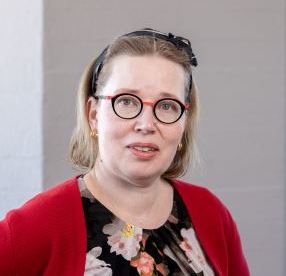
Maria Sammalkorpi

Maria Sammalkorpi

Professor (Associate Professor)
Soft Materials Modelling
  • Updated:
  • Published:
Share
URL copied!

Read more news

Unite! Seed Fund 2026: Call opens on 20 January. Applications open for student activities, teaching and learning, research and PhD.
Cooperation, Research & Art, Studies, University Published:

Unite! Seed Fund 2026: Call opens on 20 January 2026

Gain an early overview of the Unite! Seed Fund Call of Spring 2026. The call includes three funding lines: Student Activities, Teaching and Learning, and Research and PhD.
Deepika Yadav in the Computer science building in Otaniemi. Photo: Matti Ahlgren.
Appointments Published:

Deepika Yadav leverages technology to improve women's health

Deepika Yadav recently began as an assistant professor at the Department of Computer Science in the field of human-computer interaction (HCI) and interaction design for health and wellbeing.
A large cargo ship loaded with colourful containers sails across the blue ocean under a partly cloudy sky.
Research & Art Published:

Study: Internal combustion engine can achieve zero-emission combustion and double efficiency

A new combustion concept that utilizes argon could completely eliminate nitrogen oxide emissions from internal combustion engines and double their efficiency compared to diesel engines.
Microscopic view of several rod-shaped bacteria with hair-like structures, set against a dark red background.
Press releases, Research & Art Published:

A new way to measure contagion: the gut bacterium behind blood poisoning can spread like influenza

Neither the antibiotic-resistant nor the highly virulent strains are the most transmissible.