


OtaNano
OtaNano is Finland's national research infrastructure for micro-, nano-, and quantum technologies

Superconductivity is a quantum phenomenon in which all electrical resistance and energy loss disappear inside a material that is cooled to ultra-low temperatures. This saves energy since less is needed to power the device. The phenomenon is utilized in large magnets, medical imaging, and quantum devices, and it could be used to drastically reduce the energy consumption of classical computers.
But there’s an issue. Achieving superconductivity in its present-day applications requires cooling particles down to near absolute zero in expensive facilities with non-renewable natural resources like helium. It also involves sizable energy consumption by itself.
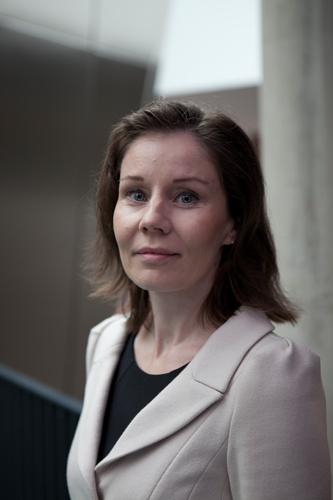
Now Professor Päivi Törmä from Aalto University’s Department of Applied Physics and the have secured highly competitive funding aimed at unlocking a potential solution: ambient room-temperature superconductivity.
If it were discovered that some materials became superconducting at higher critical temperatures at ambient pressure, many of the hurdles preventing the technology’s proliferation would be overcome. The result could be a revolution of the ICT sector that sees its energy consumption plummet, as well as boosts to quantum technology and the production of clean fusion energy that uses superconducting magnets. With the new funding, Törmä and SuperC study how quantum geometry concepts can be combined with machine learning to find new superconducting materials that work at higher temperatures.
The research is partially powered by a four-year collaborative grant provided by the Simons Foundation. Titled ‘Simons Collaboration on New Frontiers in Superconductivity’, it involves seven SuperC scientists for a total of 18 researchers from seven countries. The collaboration aims to develop a new and comprehensive theoretical understanding that goes beyond the current superconductivity theory. The collaboration is headed by Professor B. Andrei Bernevig at Princeton University with Törmä as a co-director.
‘Grand challenges such as achieving room-temperature superconductivity require a truly collaborative approach; one that unites top scientists with diverse expertise, outstanding administrative assistance, and strong support from the universities’ leadership. We have all that. With team spirit and hard work, we will succeed,’ Törmä says.

Another source of funding is a joint contribution from the Klaus Tschira Stiftung, The Kavli Foundation, and philanthropist Kevin Wells. The project is known as ‘Quantum geometry in 3D materials’ or ‘QG3D’ for short and is funded by a Kavli Exploration grant, by the Klaus Tschira Foundation, and by Kevin Wells. The project funds are distributed ɫɫÀ² and various SuperC members around Europe and the United States.
The QG3D project, led by Törmä, is seeking to create new three-dimensional materials with superconducting properties appearing at higher temperatures than in currently known compounds. Quantum geometry is a promising avenue to help identify and understand high-temperature superconductors including unconventional ones.
Törmä and her former team member, now Academy Research Fellow Sebastiano Peotta, pioneered the concept of applying quantum geometry to flat-band superconductors in 2015. Törmä’s team at Aalto, together with her international collaborators and other groups in the field, have over the years developed a deep theoretical understanding of how, under correct quantum geometric conditions, wavefunctions of electrons intertwine to create a new kind of counterintuitive superconductivity in flat bands where, naively thinking, electrons would not move at all.
QG3D pursues this understanding further with the help of AI and machine learning to speed up and directly inform the discovery process of novel superconducting materials. The QG3D project, however, goes beyond identifying new superconducting compounds: its main aim is to synthesize and characterize these compounds experimentally.
QG3D brings together eight leading theorists and experimentalists from Europe and the US. It will be integrated into the SuperC consortium. Initiated in 2022 and helmed by Törmä, SuperC gathers 14 European and American group leaders and over 50 researchers to realize a functioning room-temperature superconductor by the year 2033. In addition to the international funding, four Finnish foundations–Keele, Jane and Aatos Erkko, Magnus Ehrnrooth, and Neste and Fortum–support SuperC’s research.
The Aalto researchers use OtaNano, the Finnish national research infrastructure for nano-, micro-, and quantum technology, in their pioneering work.

OtaNano is Finland's national research infrastructure for micro-, nano-, and quantum technologies

The SuperC consortium, coordinated by Aalto, strives to find a room-temperature superconductor by 2033.


